Picture a nine-year-old who has spent the last two years in foster care. She can pack a bag in minutes. She knows the names of three caseworkers. She has learned not to unpack all the way. What she doesn’t have yet is an answer to the question every child needs someone to answer: Is this where I get to stay?
In Virginia, hundreds of children face exactly this situation. A court has ended their parents’ legal rights and changed their plan from returning home to finding an adoptive family. They are not waiting for someone to rescue them. They are waiting for a family to say yes, and to keep saying yes.
If you’re thinking about becoming a foster parent, you may have a question of your own: Can I love a child who might leave? It’s an honest question, and it deserves an honest answer. Here is the truth we want you to understand before you go any further.
The foster care system prioritizes safely reuniting children with their families. Every resource parent should work toward that outcome. Adoption becomes the plan only when a court determines, after genuine efforts toward reunification, that a child cannot safely return home. Fostering is not a shortcut to adopting a child. No agency can promise you that.
We can explain how the process works, what these children have experienced, and what the journey asks of you, so you can make an informed decision. We’ll start with the child’s perspective. Then, we’ll explore two ways families can welcome children into their homes: fostering a child whose goal is to reunite with their family, or fostering a child who needs a permanent adoptive family.
First, a few words worth knowing
This post is about adopting a child from foster care. Private and infant adoption follow different rules, timelines and costs, so they’re not covered here.
- Permanency goal: the plan the court and the child’s agency set for where the child will grow up. For most children the first goal is returning home to their parents.
- Termination of parental rights (TPR): a court order that legally ends the parent-child relationship. It happens only after a hearing, and usually after the family has had time and services to address the concerns that brought the child into care.
- Eligible for adoption: once the goal has changed to adoption and TPR has occurred, the child is legally free to be adopted.
- Resource parent: the approval a family earns to foster or adopt. Families interested in foster to adopt are approved as resource parents.
Path 1: Fostering a child whose goal is reunification
Most children who enter foster care are working toward one outcome: going home. The court and the agency are focused on reunification, and the child’s family is getting time and services to make that possible.
If you foster on this path, your job is to give the child a safe, steady home today and to support their connection to their family while the case moves forward. This also means treating the child’s parents with respect and understanding, even during challenging moments. Nationally, reunification is the most common way children leave foster care.
So you should be ready for two possible endings.
Often, the child goes home. You will say goodbye, and it will hurt. That grief is real, and it doesn’t mean the placement failed. In this path, a child returning home safely is what success looks like.
Sometimes, the child can’t. If the birth family’s challenges don’t resolve, the court may change the goal to adoption and, after a hearing, terminate parental rights. The child then becomes eligible for adoption, and you, as the family who already knows and cares for them, may be asked whether you want to be their permanent family.
You can’t know in advance which ending it will be, and neither can we. This path fits families who can hold both possibilities at once: wholehearted care for the child now, and willingness to let go if going home is the right outcome. If you could only do this with a guarantee of adoption, this may not be the right path for you, and it’s far better to learn that about yourself before a child is placed.
Path 2: Foster to adopt
Foster to adopt means you open your home only to children whose goal is already adoption and whose parents’ rights have already been terminated. The question of whether the child will go home has been answered by a court.
This path may be a better fit if you know that the possibility of a child returning to their birth family would be too difficult for you. It’s okay to recognize that about yourself, and there is a real need for families who can offer children a permanent home through adoption. This path has its own challenges, so it helps to understand them before deciding.
Who these children are
These are typically not emergency placements. The children have usually been in foster care for a long time, often years. Their birth families faced challenges that led to a hearing, a change of goal to adoption and then TPR. Many have lived in more than one home. Children waiting for adoptive families have different ages, experiences, and needs. Some are part of sibling groups, and some may need extra medical or behavioral support. Many have experienced loss and deserve patience, understanding, and care.
Who is asked first
When a child’s permanency goal changes to adoption, the child’s current foster family is usually asked first whether they would like to adopt. If the child has lived with other foster families, they may also be considered. If no family is already connected to the child, the agency searches for one through recruitment efforts. These may include profiles on sites such as VAkids Belong and AdoptUSKids, which introduce children waiting for adoptive families.
There isn’t a waiting list where families move up in order. The process depends on which children need families and whether a match is right for both the child and the family.
Matching and the six-month period
Once a family and child are matched, they have six months to see how the relationship is going. Then the official adoption paperwork begins. That time is for the child as much as for you. It lets the child settle, test whether the home feels safe, and form real attachment at their own pace.
A match is not a guarantee. If the six months show that it isn’t working, for the child or for you, that is important information. It is far better to see it early, with your agency’s support, than after the adoption is final.
What families should expect
Expect a long road: waiting for the right match, the transition, the court process and the paperwork, then years of parenting a child who may still be healing. Expect to grieve alongside your child, because even in a loving adoption, a child has lost their birth family. And expect to need help. Training, support from your agency and adoption assistance exist because this is hard work.
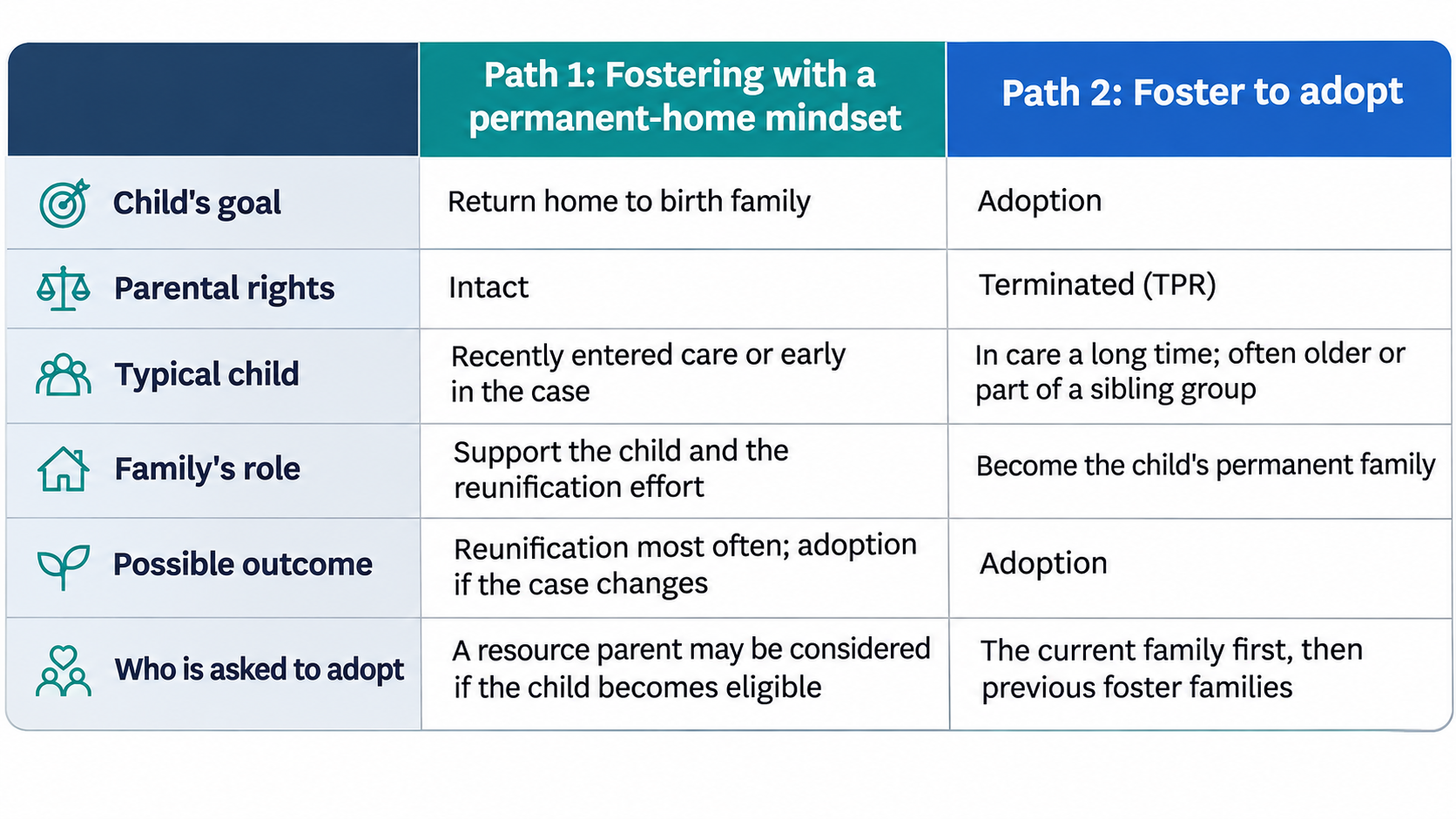
The two paths side by side
The biggest difference is the child’s legal status when they come to your home.
What these children carry, and what it asks of you
Every child in foster care has experienced loss. Even when the home they left wasn’t safe, they have lost familiar people, routines and often schools, pets and siblings. Children who become eligible for adoption have also lived through court hearings, placement changes and the legal end of their relationship with their parents. Virginia’s Department of Social Services says many of the children waiting for adoption have experienced loss, trauma or instability (Virginia DSS). Its adoption report describes children with special needs as those with significant behavioral or medical challenges who tend to be older, have been in care longer and have had multiple placements (VDSS, 2025).
Children respond to trauma in different ways, but families often see some version of these:
- Testing. A child may push away the adults who get close, to find out whether they’ll stay.
- Big reactions to small changes. Transitions, bedtime, or the end of a visit can set off a response that seems out of proportion.
- Grief that sits next to joy. A child can love their new home and still miss their birth family.
- Trouble trusting. Some children cling to every adult; others keep everyone at arm’s length.
This is not a reason to rule out adoption. It’s a reason to prepare for it. What looks like defiance often reflects what a child has experienced, and parents who understand this can make a real difference.
Questions to ask yourself before you say yes
- Can I support this child’s connection to their birth family and their story, even when it’s complicated?
- Am I willing to learn trauma-informed parenting, and to keep learning after the adoption is final?
- Do I have people around me, and professionals, I can lean on?
- Can I commit fully to this child while accepting that, for children still on the path to reunification, going home safely is the best outcome?
Support exists. Virginia offers medical and financial adoption assistance based on a child’s needs, and nationally 94% of children adopted from foster care in FY 2022 received an adoption subsidy (Adoption Council of America).
What no one can promise you
- That a child placed with you will stay. On the reunification path, going home is the goal.
- How long it will take. Court dates, hearings and appeals shift timelines, and Virginia’s own legislative review found that the TPR appeals process can add time (JLARC, 2018).
- That love alone will be enough. Children who have lost a great deal often need patience, consistency and, many times, professional support.
- That it will be easy. It can also be one of the most meaningful things you ever do.
What we can promise is honesty: we’ll tell you what we know, what we don’t, and what each path asks of you.
Adoption from foster care in Virginia: the numbers
Nationally, reunification is still the most common outcome for children leaving foster care, and adoptions from foster care have been declining. Even so, hundreds of Virginia children are waiting for a permanent family. These figures come from different agencies and years, and “waiting” can mean legally free for adoption or simply having an adoption goal, so they won’t line up exactly.
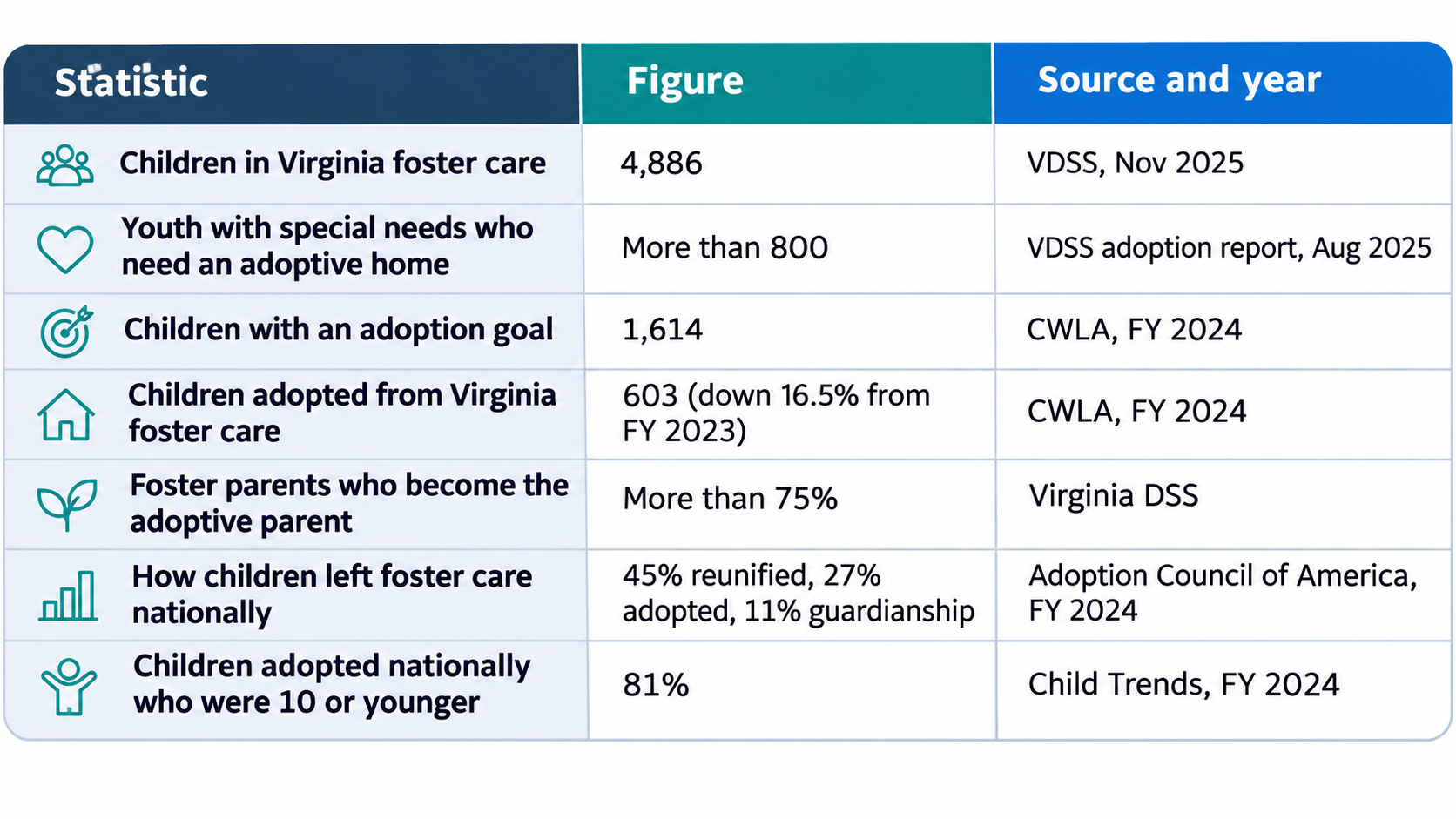
Resources: VDSS, Nov 2025, VDSS adoption report, Aug 2025, CWLA, FY 2024, Virginia DSS, Adoption Council of America, FY 2024, Child Trends, FY 2024, VDSS adoption report, as of Apr 30, 2025
What these numbers say. Going home is the goal, and nationally, the largest share of children return home. When reunification isn’t possible, older children wait the longest: 81% of children who found adoptive homes nationally in FY 2024 were 10 or younger. Interest is not the same as readiness, either. Of the 5,536 families who entered Virginia’s recruitment portal by April 2025, the state had approved 221, and its own data show the approval process typically takes three to four months. Training and preparation take time, and they should. Virginia’s legislative review also noted that appeals of terminated parental rights (TPR) can delay a child’s path to a permanent home (JLARC, 2018).
Most families pay little to nothing to adopt from foster care, and they can often receive reimbursement for any minimal costs. Depending on a child’s needs, families may also qualify for medical assistance and financial adoption assistance (Virginia DSS).
Where to start
If you’re wondering which path fits your family, start by answering the questions above honestly. Then talk with Impact a (licensed child placing agency) about becoming a resource parent.
You can also browse the children who are waiting on VAkids Belong and AdoptUSKids, or email the Virginia Department of Social Services adoption recruitment team at adoptioninquiries@dss.virginia.gov with questions.
Every child who qualifies for adoption has already experienced a great deal of change. What they need next is not a perfect family. They need a family that has prepared for the journey. One who understands their needs, has a strong support system and commits to staying.